
Solving a Sloped Yard Drainage Problem With a French Drain and Dry Well in Elmhurst, IL
When Your Yard Works Against You
There’s a particular frustration that comes with a yard that won’t drain. After every rainstorm, the same low spots fill with standing water. The same areas stay soggy for days. The lawn deteriorates in patches. Basement walls stay damp. And if your yard has any slope to it, the problem compounds — water moves fast on a grade, and without somewhere to go, it pools, erodes, and causes damage that gets more expensive to ignore over time.
This is one of the most common calls Ross & Jack’s Landscaping receives from homeowners across Elmhurst and the surrounding area. Yard drainage problems are incredibly common in the Chicago suburbs, where clay-heavy soil, flat and sloped terrain, and significant seasonal rainfall create conditions that challenge even well-maintained properties. The good news is that there are proven, professional solutions — and a properly installed drainage system can eliminate the problem for good.
Understanding the Problem: Why Sloped Yards Drain Poorly
It might seem counterintuitive that a sloped yard would have drainage problems. Doesn’t water run downhill? It does — but where it runs to matters enormously. On a sloped residential lot, water that flows down the grade has to go somewhere when it reaches the bottom. If there’s no outlet, no permeable surface, or no drainage infrastructure in place, it simply accumulates. Low spots become retention areas. Soil becomes saturated. Grass drowns. Foundations get wet.
The slope itself also accelerates erosion. Fast-moving water strips topsoil, undercuts plant roots, and carves channels through lawn areas that get worse with every storm. What starts as a soft spot in the yard can become a genuine structural and landscaping problem if left unaddressed.
The solution isn’t to fight the water — it’s to manage where it goes.
The Solution: A French Drain Connected to a Dry Well
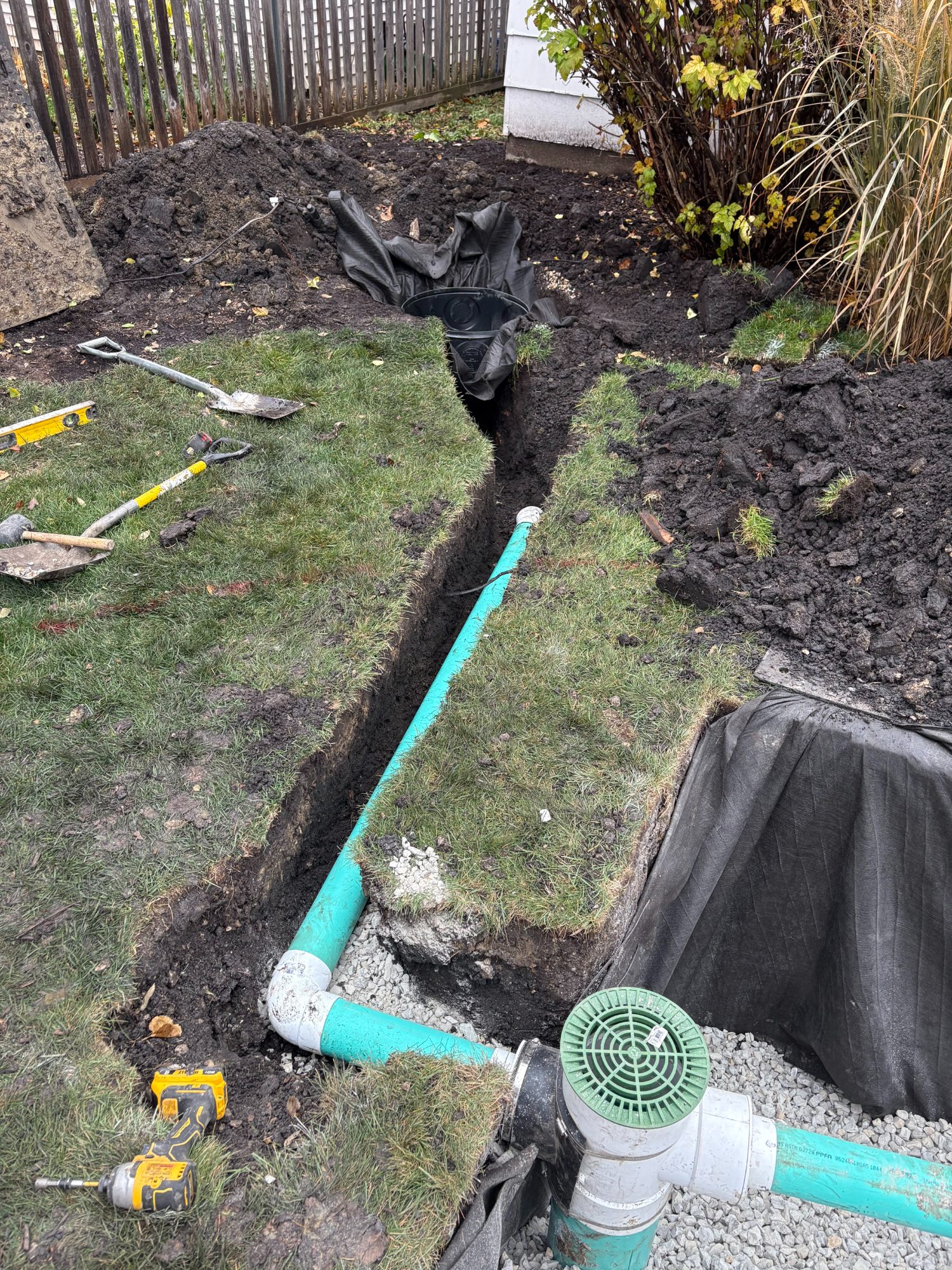
For sloped yards with significant water accumulation, one of the most effective drainage solutions is a French drain connected to a dry well. These two systems work together to collect surface and subsurface water, move it away from problem areas, and disperse it safely into the ground where it can be naturally absorbed.
What Is a French Drain?
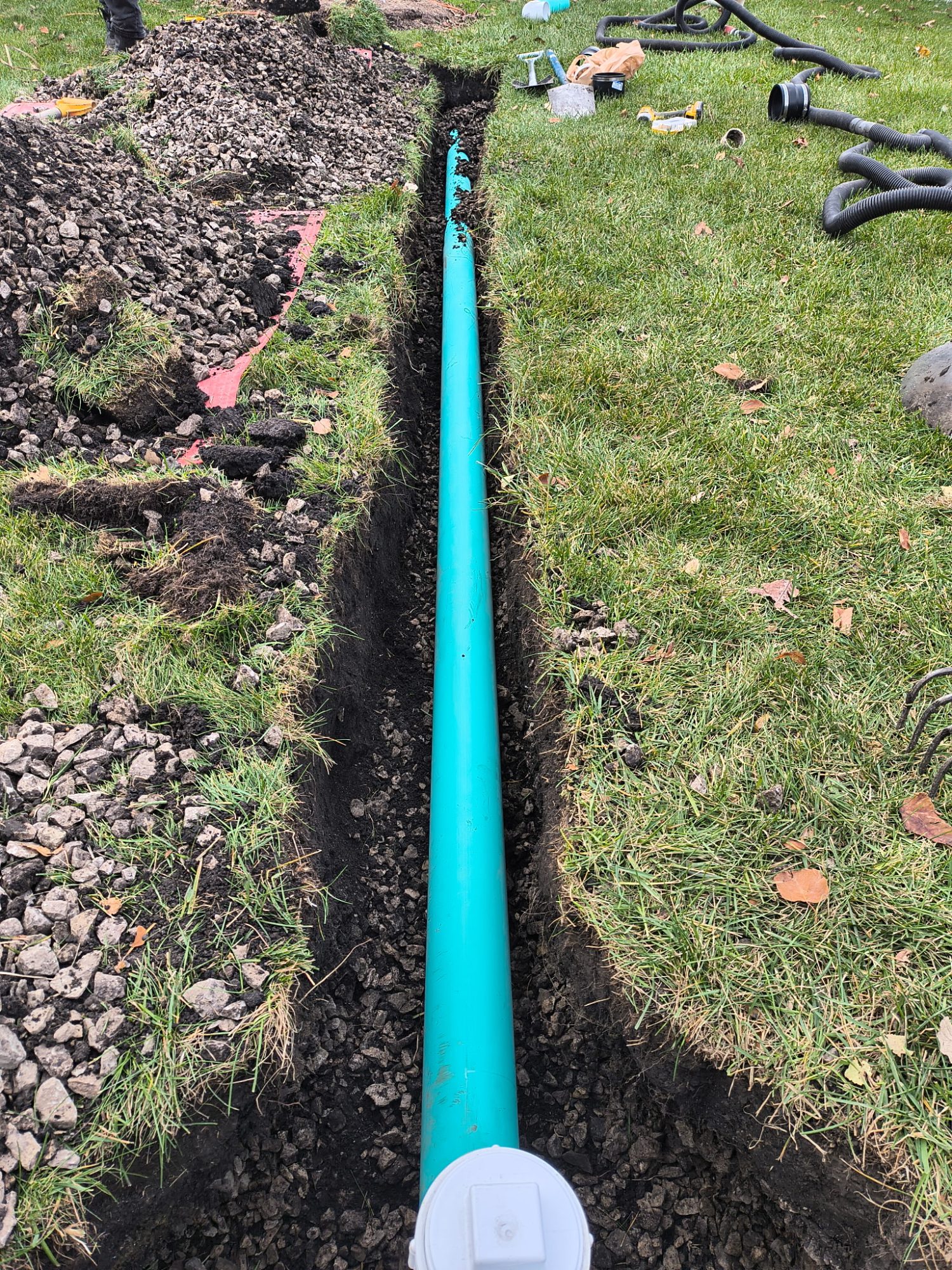
A French drain is a subsurface drainage system consisting of a perforated pipe surrounded by gravel, wrapped in landscape fabric, and buried beneath the surface of the yard. Water enters the pipe through the perforations, travels along the pipe’s length, and is directed away from the problem area toward a designated outlet — in this case, a dry well.
French drains are effective because they intercept water both at the surface and just below it, capturing runoff before it has a chance to pool. They’re installed below grade so they don’t interfere with the lawn or landscape above, and when properly installed, they’re largely invisible once the ground is restored.
What Is a Dry Well?
A dry well is an underground reservoir designed to collect and slowly disperse water into the surrounding soil. It consists of a large excavated pit lined with landscape fabric and filled with gravel, with a perforated pipe or catch basin directing water in from the French drain above.
As water fills the dry well, it gradually percolates outward through the fabric and gravel and into the native soil, where it’s absorbed naturally. This controlled dispersal prevents the water from simply moving the problem from one spot to another — instead, it gives the water a managed path to reintegrate into the ground at a rate the soil can handle.
Together, a French drain and dry well create a complete system: the French drain captures and moves the water, and the dry well receives and disperses it. For sloped yards where water accumulates at the base of the grade, this combination is one of the most reliable and long-lasting solutions available.
The Ross & Jack’s Installation Process
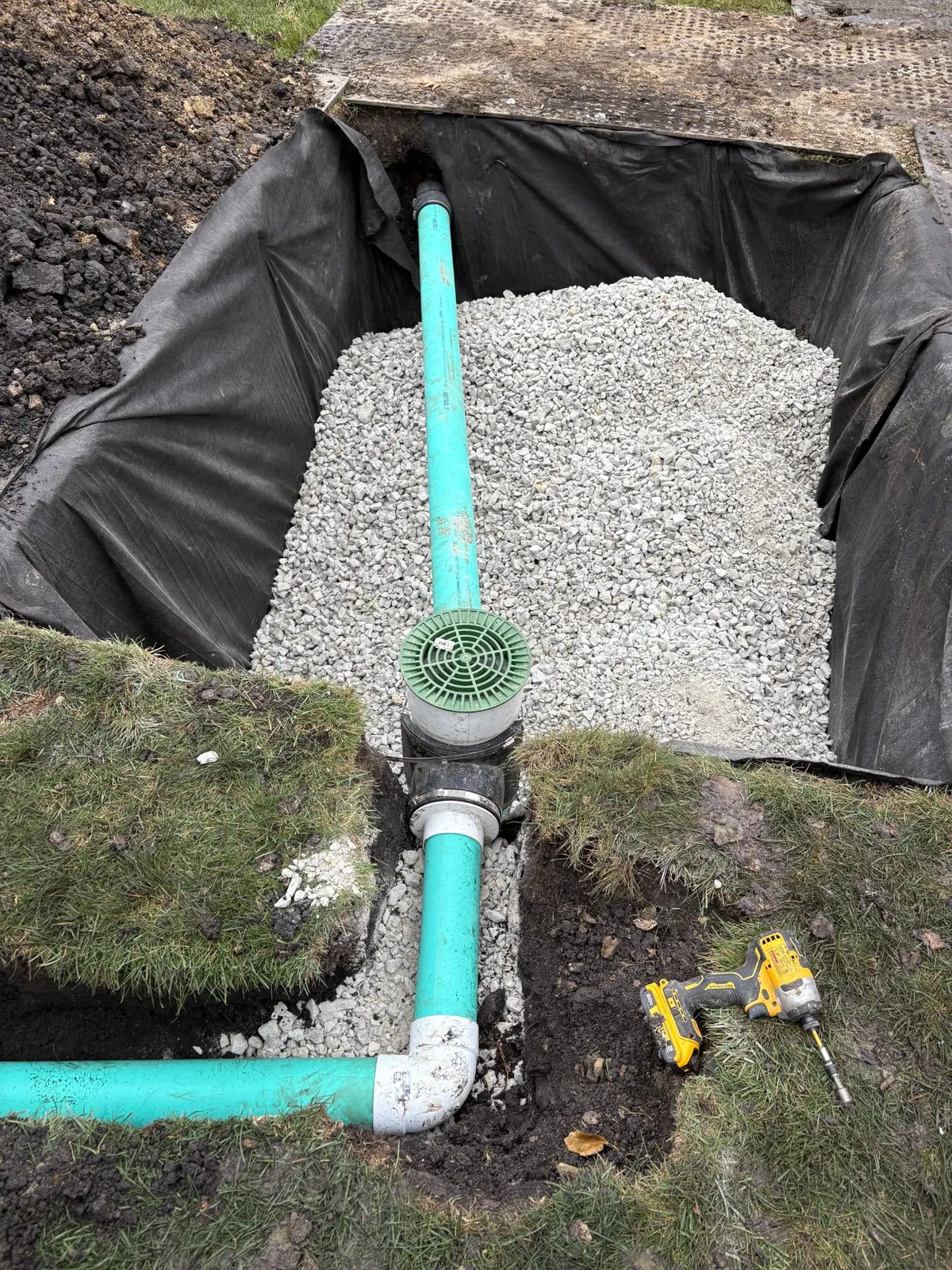
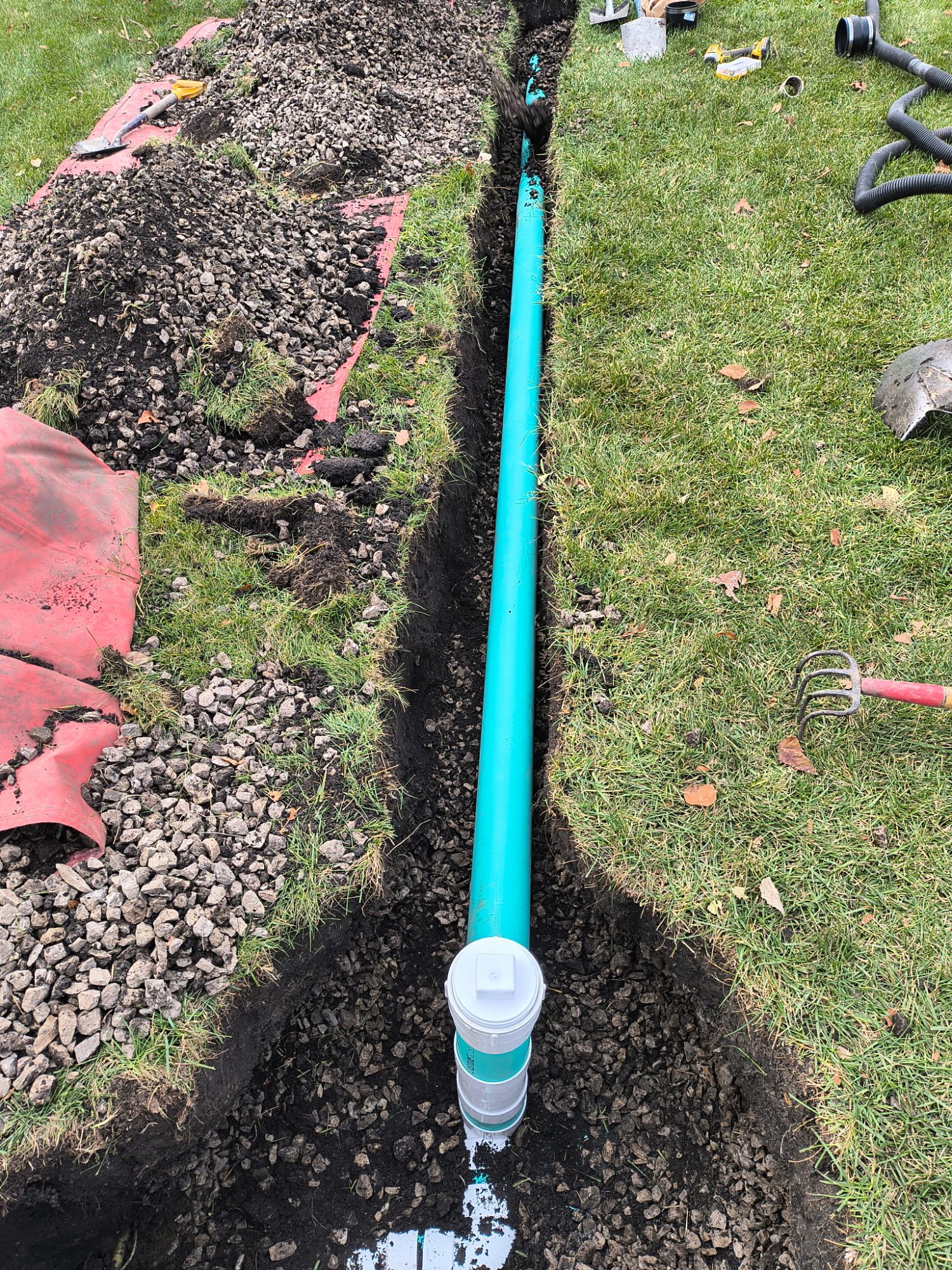
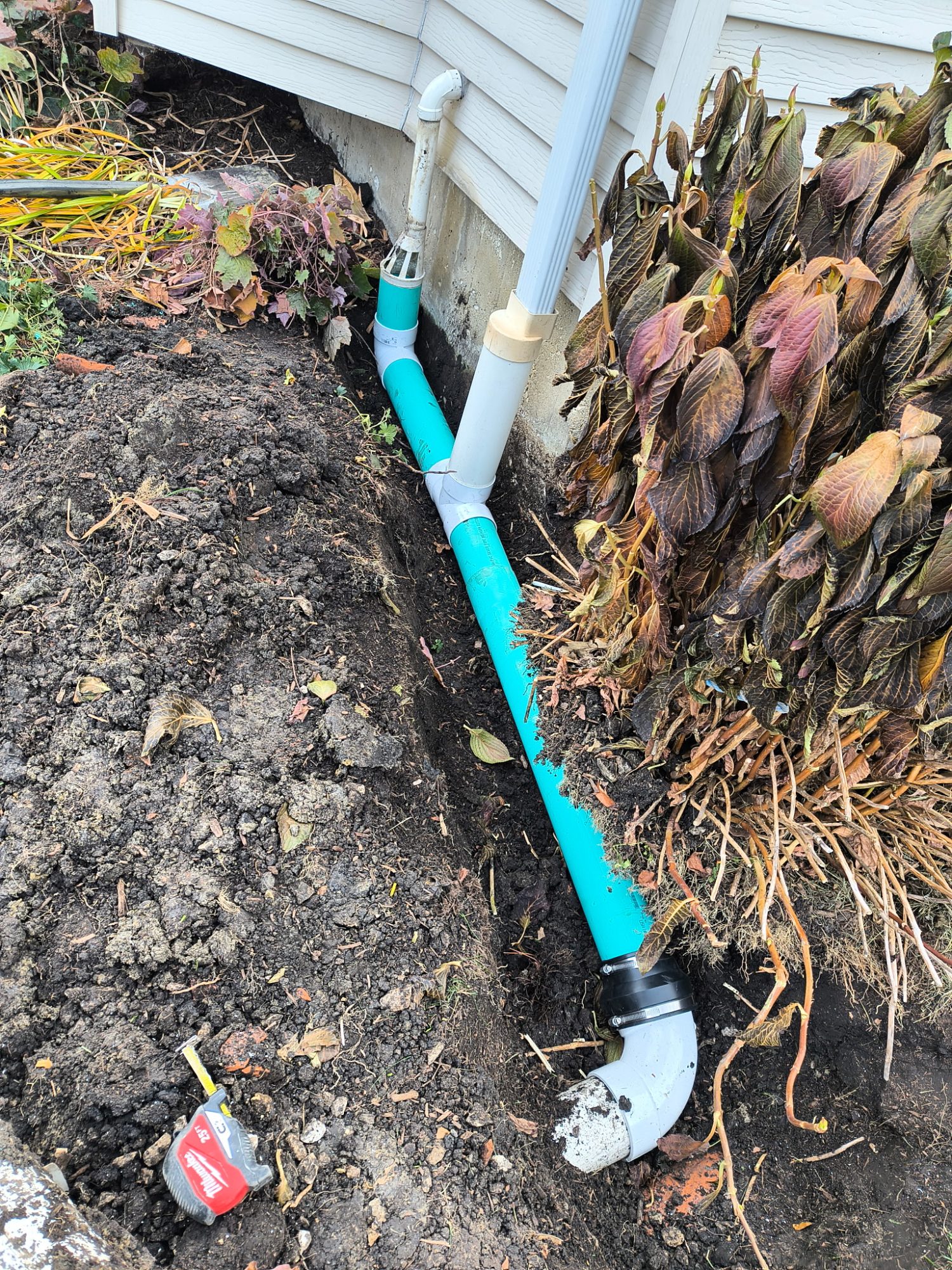
As seen in the project photos, a proper dry well installation is a significant undertaking that requires careful planning, excavation, and precise construction. The process involves excavating a large pit to the correct depth, lining it with heavy-duty landscape fabric to prevent soil intrusion while allowing water to pass through, filling it with clean gravel to create the dispersal medium, and then connecting the drainage pipe from the French drain system above.
The catch basin — the surface-level drain grate visible in the project photos — is the entry point for surface water, connecting to the pipe that leads down into the dry well below. Every connection point is engineered to handle the volume of water the system is expected to manage, and the gravel fill is sized and graded to maximize dispersal capacity.
This is precisely the kind of project where professional installation makes all the difference. A dry well that’s undersized, improperly lined, or poorly connected to the drainage pipe above will fail to perform — and the excavation and reinstallation required to fix it is far more costly than getting it right the first time.
Ross & Jack’s Landscaping has extensive experience designing and installing drainage solutions for Elmhurst homeowners, including French drains, dry wells, catch basins, and combination systems tailored to the specific conditions of each property. As a trusted Elmhurst landscaping company, the team evaluates slope, soil type, water volume, and the layout of the property before recommending a solution — because no two drainage problems are exactly alike.
Other Drainage Solutions Worth Knowing About
While a French drain and dry well combination is one of the most comprehensive solutions for sloped yard drainage, it’s not the only tool available. Depending on the specifics of your property, a drainage specialist might also recommend or combine the following:
Catch Basins
Catch basins collect surface water at low points in the yard and channel it into a pipe system. They’re often used with French drains and dry wells as the surface entry point for the overall drainage system.
Dry Riverbeds
Dry riverbeds are decorative drainage channels designed to look like a natural streambed. They guide water across the surface of the yard, directing runoff away from problem areas while adding a design element to the landscape.
Retaining Walls
Retaining walls are one of the most effective ways to manage a slope. A retaining wall holds back soil, breaks one steep grade into level sections, and slows the water that would otherwise rush downhill and carry topsoil with it. Level areas behind the wall give rainwater time to soak in instead of running off. Drainage behind the wall is built in from the start, which keeps water from building up pressure against it. A retaining wall can also create new usable space, such as a planting bed, a level lawn area, or a seat wall beside a patio. A well-designed wall solves the erosion problem and improves the look of the yard. The team at Ross & Jack’s builds retaining walls with drainage and appearance planned together, so the wall performs well and looks like it belongs on the property.
Tiered Plant Beds With Outcropping Stone
Tiered plant beds work well when a slope needs gentler control than a full retaining wall. Instead of one steep grade, the slope is shaped into a series of stepped planting beds. Each tier slows runoff and gives water a chance to absorb before it moves down the hill. Large outcropping rocks are set into the tiers to break up the flow of water, hold soil in place, and add natural texture. Layered plantings add roots that hold the soil together and take in water, and a fresh layer of mulch protects the surface from washing away. The result looks like a naturally terraced garden, and it quietly reduces runoff and erosion at the same time. It’s a good option when you want a slope to feel like a landscaped feature rather than a drainage fix.
Downspout Extensions and Drainage Pipes
Downspouts redirect roof runoff away from the foundation and toward a safe outlet, rather than letting it pool next to the house.
A qualified yard drainage specialist will evaluate which combination of solutions makes the most sense for your property. Sometimes it’s one approach, and sometimes it’s several working together.
Is Your Yard Telling You It Has a Drainage Problem?
Standing water after rain, soggy patches that never fully dry out, erosion channels forming in the lawn, water staining on the foundation, or a basement that smells musty after storms — these are all signs that your yard’s drainage system isn’t doing its job. In the Chicago suburbs, where clay soil and flat or sloped terrain are common, these problems are more the rule than the exception.
The sooner a drainage problem is addressed, the less damage it causes — to the lawn, to the landscape, and to the structure of the home. Ross & Jack’s Landscaping is ready to evaluate your property and recommend the right solution. Reach out today to schedule a consultation.
Frequently Asked Questions
What is a French drain and how does it work?
A French drain is a subsurface drainage system that uses a perforated pipe surrounded by gravel and wrapped in landscape fabric, buried beneath the surface of the yard. Water seeps into the pipe through the perforations and is directed away from the problem area toward a safe outlet such as a dry well, a storm drain, or a lower point on the property. French drains are effective at capturing both surface runoff and subsurface water that accumulates just below the lawn.
What is a dry well and when do you need one?
A dry well is an underground pit lined with landscape fabric and filled with gravel that collects water from a drainage system and slowly disperses it into the surrounding soil. It’s typically used when there’s no natural outlet for drainage water — such as when the property is landlocked or when directing water to the street or storm drain isn’t practical. A dry well gives the water a managed place to go and allows it to reintegrate into the ground at a controlled rate.
How do I know if my yard needs a French drain?
Signs that your yard may benefit from a French drain include standing water after rain that takes more than 24 to 48 hours to drain, consistently soggy or soft areas in the lawn, erosion channels forming on slopes, water pooling adjacent to the home’s foundation, or a basement that experiences moisture intrusion after heavy rain. A professional drainage evaluation can confirm whether a French drain is the right solution for your specific situation.
Can a French drain and dry well solve a sloped yard drainage problem?
Yes — for sloped yards where water accumulates at the base of the grade, a French drain and dry well combination is one of the most effective solutions available. The French drain intercepts water as it flows downhill and channels it into the dry well, which then disperses it safely into the ground. This combination addresses both the movement of water and its final destination, preventing it from simply pooling in a new location.
How deep does a French drain need to be?
Depth depends on the specific drainage problem being addressed. French drains designed to intercept surface runoff are typically installed relatively shallow, while those intended to capture subsurface water may need to go deeper. A drainage professional will determine the appropriate depth based on the slope of the property, the soil type, and where the water is entering the system.
How long does a French drain last?
A properly installed French drain with quality materials can last 30 to 40 years or more. The most common cause of French drain failure over time is soil and root intrusion into the pipe, which can be minimized with proper landscape fabric wrapping and quality pipe selection. Professional installation with appropriate materials is the single most important factor in the long-term performance of any drainage system.
What is the difference between a French drain and a dry well?
A French drain is a linear drainage system — a pipe that moves water from one location to another. A dry well is a collection and dispersal point — it receives the water that the French drain delivers and slowly releases it into the surrounding soil. The two systems are complementary and are frequently installed together: the French drain captures and transports water, and the dry well receives and disperses it.
Will a French drain or dry well work in clay soil?
Clay soil is challenging for drainage because it absorbs water slowly. A dry well in heavy clay soil will disperse water more slowly than one in sandy or loamy soil, which means sizing the system appropriately for the expected water volume is especially important. In some cases, additional solutions such as regrading or supplemental drainage features may be combined with a dry well to achieve the best results. A drainage specialist familiar with local soil conditions — like those commonly found in the Elmhurst area — will account for this during the design phase.
How much does a French drain and dry well installation cost in Elmhurst, IL?
Cost varies based on the size of the drainage problem, the depth and length of the French drain, the size of the dry well required, soil conditions, and whether any additional drainage features are needed. Because every property is different, the best way to get an accurate estimate is to schedule a professional drainage evaluation so the contractor can assess the specific conditions and recommend the right solution.
Do I need a permit for a drainage system installation in Elmhurst, IL?
Some drainage installations require permits depending on the scope of the work and local municipality requirements. Projects that involve significant excavation, connection to storm sewer systems, or major regrading may require permits and inspections. Ross & Jack’s Landscaping is experienced with local permitting requirements in Elmhurst and will advise you on what applies to your project.
Can yard drainage problems damage my home’s foundation?
Yes — persistent water accumulation adjacent to a home’s foundation is one of the leading causes of foundation damage, basement moisture intrusion, and structural issues over time. Water that pools against the foundation creates hydrostatic pressure that can cause cracking, seepage, and long-term deterioration. Addressing yard drainage problems proactively is far less costly than repairing foundation damage after the fact.
What is a dry riverbed and is it a good drainage solution?
A dry riverbed is a decorative surface drainage channel designed to mimic the appearance of a natural streambed, using river rock and boulders to guide water flow across the yard in an attractive way. It’s a good solution for properties where surface water needs to be directed across open areas and where a visually appealing design element is desirable. It’s often used in combination with other drainage solutions as part of a comprehensive yard drainage plan.
How long does it take to install a French drain and dry well?
Installation time depends on the size and complexity of the system. A straightforward French drain and dry well installation for a residential property typically takes one to three days. Larger or more complex drainage projects involving multiple catch basins, longer pipe runs, or significant regrading may take longer. Your contractor will provide a timeline during the proposal phase.
What landscaping company in Elmhurst installs French drains and dry wells?
Ross & Jack’s Landscaping is an experienced drainage solution contractor serving Elmhurst, IL and surrounding communities. The team designs and installs French drains, dry wells, catch basins, and comprehensive yard drainage systems tailored to the specific conditions of each property. Contact Ross & Jack’s to schedule a drainage evaluation and get a professional recommendation for your yard.